Out in the garden, the chives are gorgeous, as are the rosemary, sage, thyme, oregano, basil, parsley, and dill. Next spring, when the chives are covered in pink blossoms, I intend to pick some, pack them into a nice jar, and fill it with white vinegar.
Author Archives: Dr. Sukol
YOUR HEALTHY PLATE: Cabbage with Apples & Onions
The fall has been my favorite time of year since I was a little girl. Crisp air, crisp apples, cozy sweaters, and cleaning out the garden make me really happy. Here is a little something you can do with the cabbages and apples that have been ripening in recent weeks. The ingredients may seem less than inspired, but the result is truly delicious.
If you’ve never visited “Your Health is on Your Plate” before, visit Lets Start at the Very Beginning to get a jumpstart protecting the health and well-being of the ones you love!! Then check out “A Milestone Celebration — Your Favorite Posts” and “The Most Popular Blog Posts of All” for more great ideas and recipes!
2 tablespoons olive oil
1 large Vidalia onion, sliced thinly (after peeling)
2 macintosh apples, sliced thinly (core removed)
1 medium cabbage, sliced thinly (core removed)
1 teaspoon kosher salt
1/4 cup apple cider vinegar
Fry onion in hot olive oil in a large skillet on high heat until the onions are translucent and browning at the edges. Add apples and fry 2-3 more minutes. Reduce heat to medium, add cabbage, stir well, and cook for 5 more minutes.
Add cider vinegar and simmer, covered, for 20 minutes or until the cabbage is getting soft. Remove the cover, turn heat back up, and continue to cook until most of the liquid has evaporated. Sprinkle with salt and serve.
P.S. If you don’t have time to do all this, dump all the ingredients into a crock pot, add 1/2 cup cider vinegar and 1/2 cup extra water, and leave it to cook all day. The result will be different, but equally delicious.
Follow Dr Sukol’s posts on Twitter @RoxanneSukolMD and on Facebook at Roxanne Breines Sukol and at Your Health is on Your Plate.
A Hidden Truth About Calories
Science writer Rob Dunn’s article, The Hidden Truth About Calories, recently published in Scientific American, explains why two people could each gain different amounts of weight even though they eat the same diet. It looks like our visible, apparent differences don’t even begin to scratch the surface. For just one thing, it turns out that individuals of Russian descent have guts that are five feet longer, on average, than those whose grancestors (okay, I made that up — I intend it to mean just a few generations ago) came from Italy.
Dunn points out that our bodies weren’t designed to eat processed items that have already had much of the work of digestion completed before we eat them. In nature, there is no such thing as plant-based carbohydrate without its fiber matrix. Think about it: Vegetables, beans, fruits, and grains are the four classes of carbohydrate. And if you pick them from a tree, or a garden, or a meadow, you find yourself holding a fiber-rich source of calories in your hand.
Dunn says that “Over the last thirty years the number of calories we eat has increased, but so has the number of those calories that come from highly processed foods. In this light, we would do well to eat fewer processed foods and more raw ones.” Okay, I buy that. He’s right, but not because of the calories. He’s right mostly because of the nutrients.
It’s not just the fiber that’s missing in stripped carbs. It’s the nutrition. He mentions this in passing (and in parentheses) with “Such foods, after all, tend to have more nutrients such as B vitamins, phytonutrients and minerals and so are good for reasons having nothing to do with counting calories.” And therein lies the pearl.
It’s not just that processed items are easier to digest and so provide more calories (and weight). It’s that they are relatively bankrupt in nutrition, so our desire for Food (with a capital F!) is not satisfied. Which keeps us hungry, all the time.
This is why we can easily scarf down several large bags of Doritos over the course of a ball game, or tip a full sleeve of thin mint cookies right down our gullets. And yet we can’t finish all the lettuce at the bottom of a giant-sized chef salad, or feel good about draining even just a teacup filled to the top with first-press, extra-virgin olive oil. Nutritious food is filling.
It’s not mainly about the calories, Rob Dunn. It’s about the nutrition.
YOUR HEALTHY TABLE: Happy New Year
It’s almost the New Year, when we make a special effort to prepare sweet dishes and wish each other a “Sweet New Year.” We’ve been preparing meals since earlier this morning, and are looking forward to celebrating with our friends and family. Here’s what’s on the menu tonight:
Turkey-Squash Soup
This past Wednesday, the bone from a turkey breast (plus a teaspoon of cider vinegar) was simmered after dinner for several hours in water that was left after cooking a dozen ears of corn. After cooling, I retrieved the pot from the refrigerator this morning, stripped the bits of turkey meat into the stock, discarded the bone, and began chopping vegetables. These included a bag of carrots, 6 stalks of celery, one large tomato, and a gorgeous, dark-orange squash purchased for me at a local farmer’s market by a dear friend. I added paprika, turmeric, salt & pepper, and a generous pinch of saffron. It’s all about the flavor.
Green-leaf Lettuce Salad
Dressed with extra-virgin olive oil and kosher salt
Braised baby beet leaves
Planted a few weeks ago, and picked from the garden this afternoon!
Green tomato relish
Adapted from:
http://www.theatlantic.com/health/print/2009/07/how-to-eat-summer-food-all-year/21999/
With half the brown sugar, twice the red pepper flakes, a large orange (peeled and seeded), and hot pepper jelly instead of orange marmalade.
Roasted turkey
Chief-Cook-and-Bottle-Washer’s secret recipe
Roasted Yukon potatoes
Washed and cut into 1 inch cubes, mixed with olive oil, paprika, and kosher salt
Roasted carrots
Scrubbed and left whole, with 2-3 inches of green tops left intact, with olive oil and salt
Brownies served with fresh berries
Black-bean chocolate fudge
“You can never have too many chocolate desserts.”
Best wishes to all for a happy and healthy new year!
YOUR HEALTHY PLATE: Cha-Cha Hot Sauce
Here’s What to Know About Dried Fruit
familiar with it, if they would have recognized it as food. And, of course, the answer to this question would be yes. “Is an invention of the 20th century?,” I could ask. And, of the course, the answer would be no. As long as there have been vines and bushes, trees and sunshine, there has been dried fruit.
So which is it? Is dried fruit high in sugar, or not? Yes, but that’s not the whole story.
To dry fruit is to dehydrate it. The process of dehydration removes water, but not fiber. And not sugar either. This means that the sugar with which the apple, or peach, or grape, or plum started out remains constant. The same amount of sugar in a smaller amount of water means that the fruit sugar becomes more concentrated as the amount of water decreases. So yes, it’s true: fruit contains a lot of sugar. BUT.
But it remains trapped within its fiber matrix, and that affects the rate at which the
sugar is released.
jerky, the answer is yes, it’s high in sugar. But if you compare it to a fruit yogurt sweetened with high-fructose corn syrup, or to candy, or even to a store-bought bran muffin, then no, it’s not high in sugar.
better than you tolerate fresh fruit. But if you can eat an apple without any problem, then you can likely eat dried apple slices just as well. If you drink a glass of water with your dried fruit, that’s pretty close to simply eating fresh fruit in the first place.If you’re still concerned about how dried fruit affects your blood sugars, check your blood sugars about an hour after eating your snack. If they’re higher than you want, then you could decrease the total amount you eat, or you could try it with some peanut butter, or dark chocolate, for example, to cut the absorption rate. And remember that some dried fruits, just like fresh fruits, have more sugar than others.
YOUR HEALTHY PLATE: Watermelon-Cucumber Gazpacho
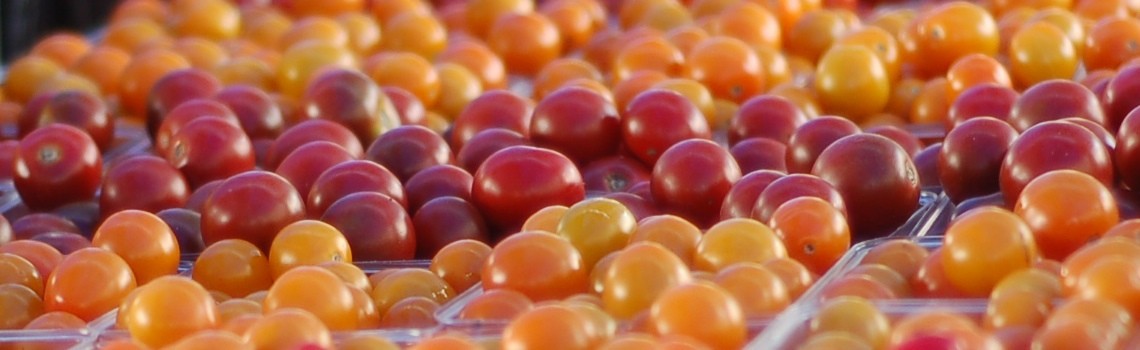
Today at the Farmers’ Market the produce was gorgeous. I purchased a quart of zebra tomatoes, so named for their magnificent alternating lime and dark-green stripes, a quart of rainbow-colored cherry tomatoes, a large bag of long and lovely purple eggplants, a mix of spicy greens, and a few other goodies.
I was intent on making a traditional tomato gazpacho, but at the last minute I decided on this beautifully different gazpacho instead. Think of gazpacho as salad soup.
8 cups watermelon (peeled from rind, seeded, and chopped)
3 small-medium pickling cucumbers, diced
1 red bell pepper (cored, seeded, and diced)
1/4 cup fresh basil, chopped
1/4 cup flat-leaf parsley, chopped
3 tablespoons red wine vinegar
2 tablespoons green onions, chopped
3 tablespoons extra-virgin olive oil
3/4 teaspoon salt
Mix together all the ingredients in a large bowl.
Blend approx 2-3 cups of the ingredient mixture in a blender or food processor, pulsing until chunky, not smooth. Collect the blended mixture in a second bowl.
Continue to blend one small batch at a time until approx 1/2 cup of the original mixture remains. Add this to the contents of the second bowl as is, without processing, and stir. Refrigerate for at least 2 hrs, and serve chilled. Garnish with basil or parsley. Yield: 6-7 cups
Follow Dr Sukol on Twitter @RoxanneSukolMD and on Facebook at Roxanne Breines Sukol.
A Healthy Lifestyle
Lots of people are talking these days about lifestyle change. What is a healthy lifestyle? For me, it was yesterday. Literally. I need to preface this week’s post with a caveat: Not enough of my days are like yesterday. In general, I spend way too many hours seated at my desk with my face stuck to the computer screen. I spend too much time worrying about what’s next instead of appreciating what’s now. And although I follow my own advice carefully with regard to eating real food and avoiding most manufactured calories, I eat too many meals quickly, and with only myself for company.
But yesterday was a winner. Lifestyle-wise, it was a great day! Here’s what a great day looks like in my book. Very importantly, I went to bed at a reasonable hour the previous evening, so when I awoke just before 8 a.m., I was exceedingly well rested. I dressed, poked around in the refrigerator, identified some cold salmon (leftovers) and cucumber slices as likely candidates for breakfast, and enjoyed them with a cup of coffee as I stared out the window into my backyard at the oak, spruce, and chicken coop. All was quiet, and all looked well. This I followed with a long walk in the cool morning, planned to avoid being hit with the heat and humidity of the day.
I enjoyed reading, sang a little, and then met up with a group of friends for lunch. We had tilapia sprinkled with paprika, hummus with celery sticks, homemade tomato- vegetable soup steaming in the crock pot, a bee-yoo-ti-ful green salad with fresh peas, parsley, romaine, and other greens, and fresh grapes and cherries set out on the table for dessert. We laughed and told stories, we discussed a book we’d all read, and, very importantly, we took a long time to eat lunch.
I got home late in the afternoon, just in time for a short walk in the neighborhood with a friend. I’m not sure what I did after that, but I do know that I spent some time reading up on some knitting stitches I’d been wanting to learn.
I ended the day by cuddling up with Chief-cook-and-bottle-washer plus a large bowl of popcorn (fresh popped in olive oil, and sprinkled with turmeric) to watch Cinema Paradiso, a 1990 Oscar-winning movie, which I highly recommend even if you don’t care for foreign films. If you’ve never seen it, you’re really missing something.
Yesterday contained all the components of a healthy life: physical activity, nourishing food, companionship, rest and relaxation.
YOUR HEALTHY PLATE: Zucchini Walnut Bread
This recipe is adapted from the kitchen of my friend Toby. In addition to being the mother of several expert zucchini (and berry) pickers, she always knows where to find the best produce, and then turn it into magical and delicious recipes for her beautiful family!
Grease and flour two 8×4-inch loaf pans. Preheat the oven to 325 degrees F. Sift together the flour, salt, baking powder, baking soda, and cinnamon in a small-medium bowl. In a large bowl, beat together the eggs, olive oil, vanilla, and honey. Add the dry ingredients to the wet mixture, and beat well. Stir in the grated zucchini and nuts until well combined, and pour the batter into the prepared pans. Bake for 40-60 minutes or until a tester inserted in the center comes out
clean. Cool the pans on a rack for 20 minutes, and then remove the breads from the pans and allow them to cool completely.
Awesome trick: If you use the same measuring cup to measure out first the olive oil and then the honey, all the honey will slide out easily and none will stick to the sides.
Also: This batter works well for making muffins too. The baking time will go down to about 20-23 minutes.
———————————————————————-
Follow Dr Sukol on Twitter @RoxanneSukolMD and on Facebook at Roxanne Breines Sukol.
A Primer About Fats
Fats, as I like to say, are not the bad guy. Our brains are made of fat, and our nerves are insulated by fat. Our cell membranes are composed of fat, which makes sense when you think about it. After all, we’re made mostly of water, and we know that fat [or oil, which you may use interchangeably in this post] and water don’t mix.
When Nature needed to figure out a solution that would keep our water component from leaking onto the floor whenever we stood up, fat was the answer. When Nature needed to figure out how to keep the contents of our acidic stomach from mixing with the contents of our basic intestines, which would neutralize everything and prevent our digestion from working right, again it turned to fats. Fats are an ideal way to keep various water solutions separate from one another.
Because oil and water don’t mix, Nature used fats to make cell membranes. These cell membranes serve as envelopes to keep their watery worlds inside. That’s an essential job, so it isn’t a stretch to say that fats are essential to life.
In addition to that, fats carry all the fat-soluble vitamins (all of them, except Vitamin C and the B vitamins, which are water-soluble). So if you eat a diet that is deficient in fat, there is a good chance that you will also be deficient in fat-soluble vitamins. I see this frequently in the office.
Here is some information about fats to give you insight into the structure of fats. I am sharing this information because I think that the better we understand what fats are, the less susceptible we will be to the industrial vilification that influences consumers to purchase more products that are made of stripped carbohydrates and industrially-modified fats.
At a molecular level, fats consist of a backbone with three tails. Think of the letter E. The fat molecule’s backbone is a sugar-like compound called a glycerol. The tails are fatty acids. A fatty acid is a chain of carbon molecules. Some chains are very short and others are long, from just a few carbons to more than 20 in length. Sometimes two are the same fatty acid and one is different; sometimes all three are different. Occasionally all three are identical.
Because each fatty acid in a fat molecule is different, it is usually more accurate to say that each fatty acid has a particular property than to describe the entire fat with one word. Describing a fat as having a particular property can be misleading. It’s better to describe each fatty acid in the fat, since they are often different. That way it’s like describing each of three triplets by their individual characteristics [He likes dinosaurs, she is taking gymnastics, and he’s in a size 8 shoe.] as opposed to describing them all in a single blanket statement [They’re almost 5.]. You get a lot more information.
Most fats, as I’ve said, are composed of a mix of fatty acids. For example, the fat molecules in cocoa butter are composed of approximately 1/3 monounsaturated and saturated fatty acids. Olive oil is composed of approximately 33% monounsaturated and 16% saturated fatty acids. The rest is a mix of fatty acid types. Almond oil is approximately 10% monounsaturated, 30% saturated and 60% polyunsaturated. Chicken fat is approximately 42% monounsaturated, 21% polyunsaturated and 35% saturated fatty acids. There’s a significant amount of variability, which accounts for the fact that it doesn’t add up to 100%.
Ready for more? Omega 3’s and omega 6’s are two different kinds of polyunsaturated fats. Omega 9’s are a type of monounsaturated fat. Counting from the tail of the fatty acid molecule, the number (3, 6 or 9) corresponds to the first double bond encountered in the chain. Sometimes the entire chain has only one double bond. We call this a monounsaturated fatty acid. Sometimes it has no double bonds. We call this a saturated fatty acid. Sometimes it has two or more double bonds, in which case it’s called a polyunsaturated fatty acid.
It’s counterintuitive, but double bonds are not twice as strong as single bonds. They are much less strong, which makes them much more reactive. The more reactive a bond, the less stable it is. More on this another time.
Why is this important? Because the better we understand it, the better we’ll be at choosing foods that nourish us. And no advertising strategy will be able to change our minds.